Compare Products
Hide
VS
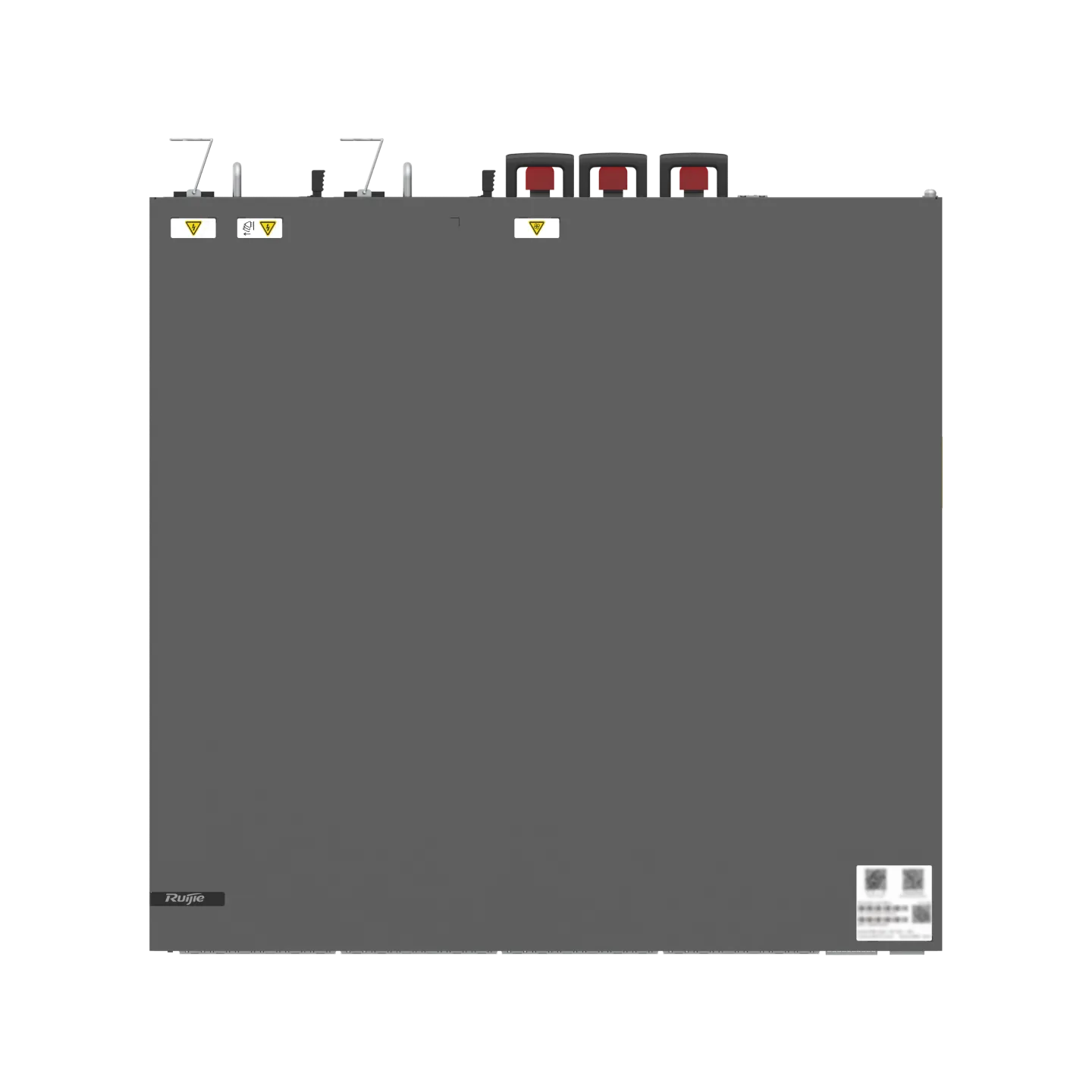
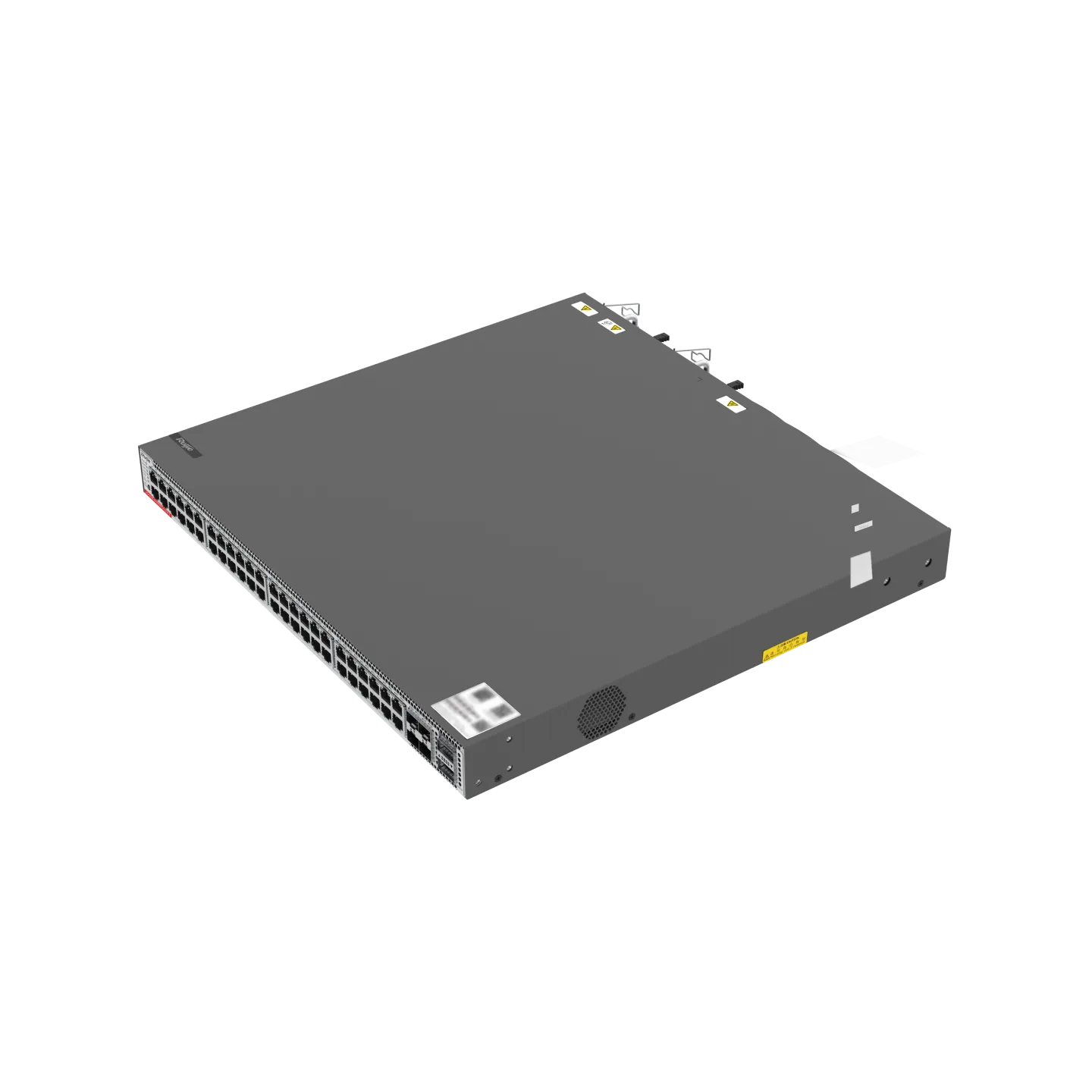
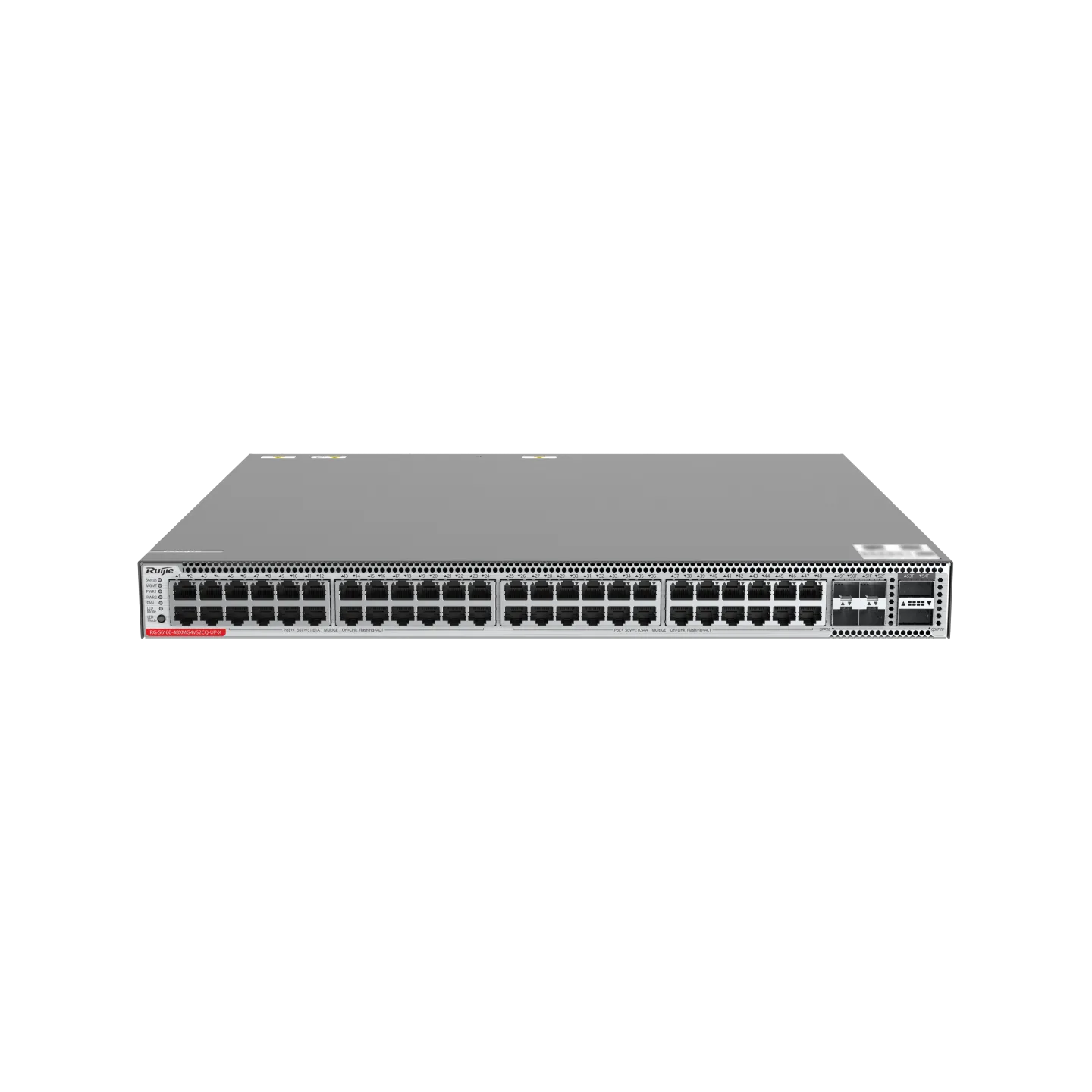
100/1000/2.5G/5G/10GBASE-T ports, PoE/PoE+/PoE++, 4 x 25GE SFP28 ports and 2 x 100GE QSFP28 ports, offering flexible networking options to build high-performance campus networks
| Port specifications |
RG-S6160-48XMG4VS2CQ-UP-X |
| Fixed service port |
48 x 100/1000/2.5G/5G/10GBASE-T ports ● Ports 1 to 24 support PoE/PoE+/PoE++ ● Ports 25 to 48 support PoE/PoE+ 4 x 10GE/25GE SFP28 ports 2 x 40GE/100GE QSFP28 ports |
| Module slot |
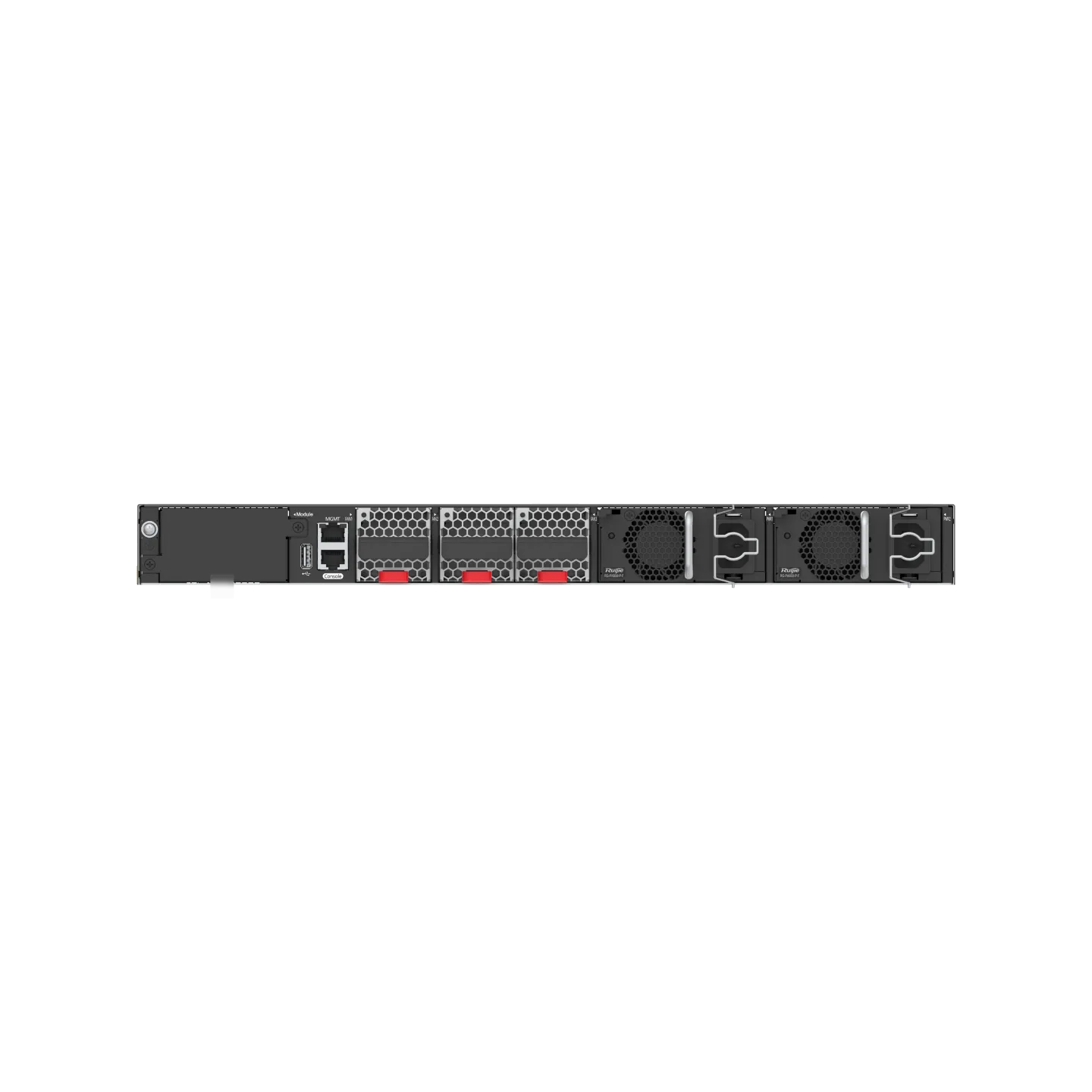
2 x power module slots 3 x fan module slots |
| Power module |
RG-PA600I-P-F RG-PA1000I-P-F |
| Fan module |
Pre-installed 3 |
| Fixed management port |
1 x RJ45 console port 1 x RJ45 MGMT port |
| USB |
1 x USB 2.0 port |
| System specifications |
RG-S6160-48XMG4VS2CQ-UP-X |
| System packet forwarding rate *1 |
1160.64 Mpps |
| System switching capacity *2 |
1560 Gbps |
| Real-time clock (RTC) |
Supported |
| BootROM |
1 |
| Number of MAC addresses |
Number of global MAC addresses: ● 128K(Default) ● 384K(Max) |
| Dimensions and weight |
RG-S6160-48XMG4VS2CQ-UP-X |
| Unit dimensions (W x D x H) |
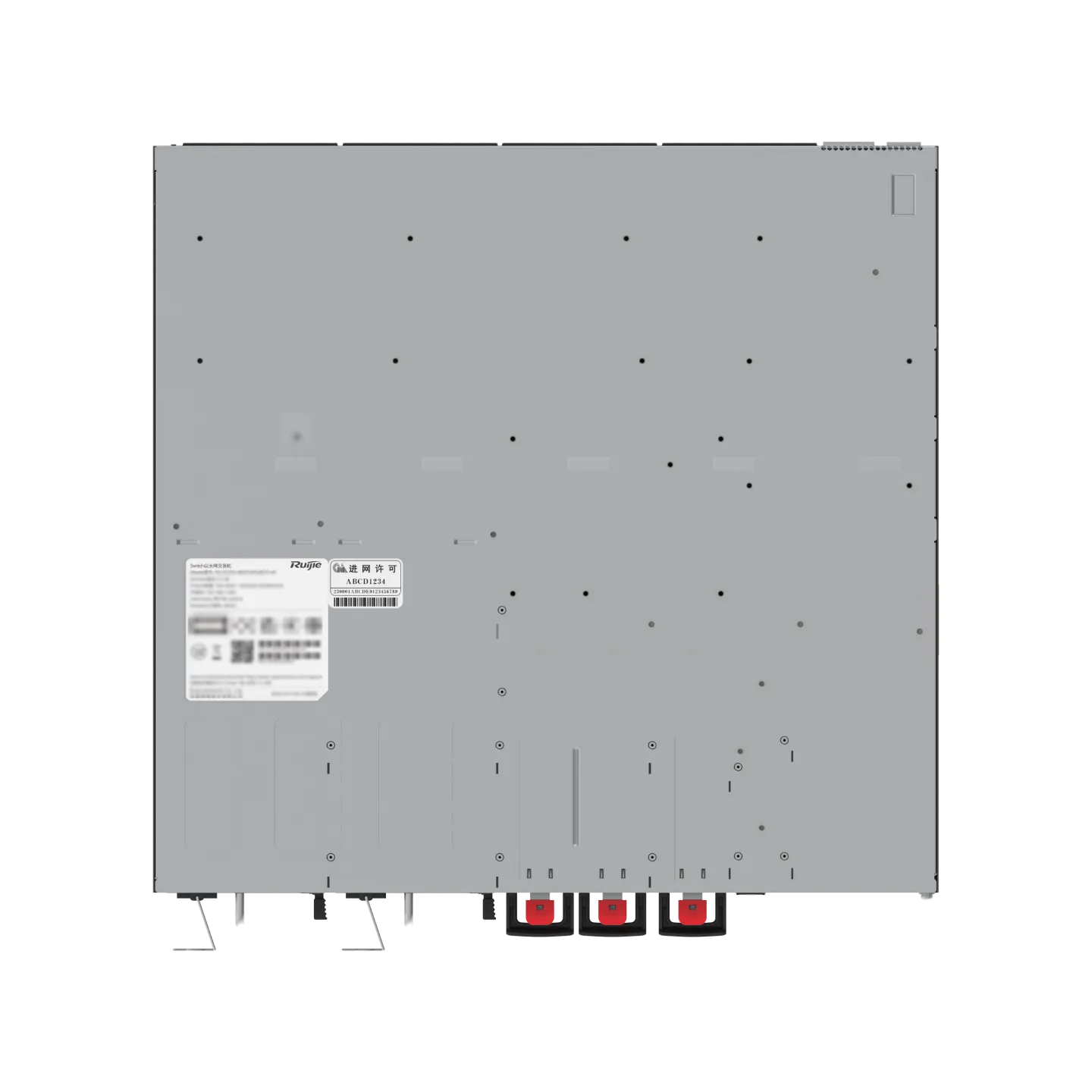
442.0 mm x 420.0 mm x 43.6 mm (17.40 in. x 16.54 in. x 1.72 in.) |
| Rack height |
1 RU |
| Environment and reliability |
RG-S6160-48XMG4VS2CQ-UP-X |
| Temperature |
Operating temperature: 0°C to 45°C (32°F to 113°F) Storage temperature: -40°C to +70°C (-40°F to +158°F) Note: At an altitude between 3,000 m (9,842.52 ft.) and 5,000 m (16,404.20 ft.), every time the altitude increases by 220 m (721.78 ft.), the maximum temperature decreases by 1°C (1.8°F). |
| Humidity |
Operating humidity: 10% to 90% RH (non-condensing) Storage humidity: 5% to 95% RH (non-condensing) |
| Altitude |
Operating altitude: -500 m to +5,000 m (-1640.42 ft. to +16,404.20 ft.) Storage altitude: -500 m to +5,000 m (-1640.42 ft. to +16,404.20 ft.) |
| Fan |
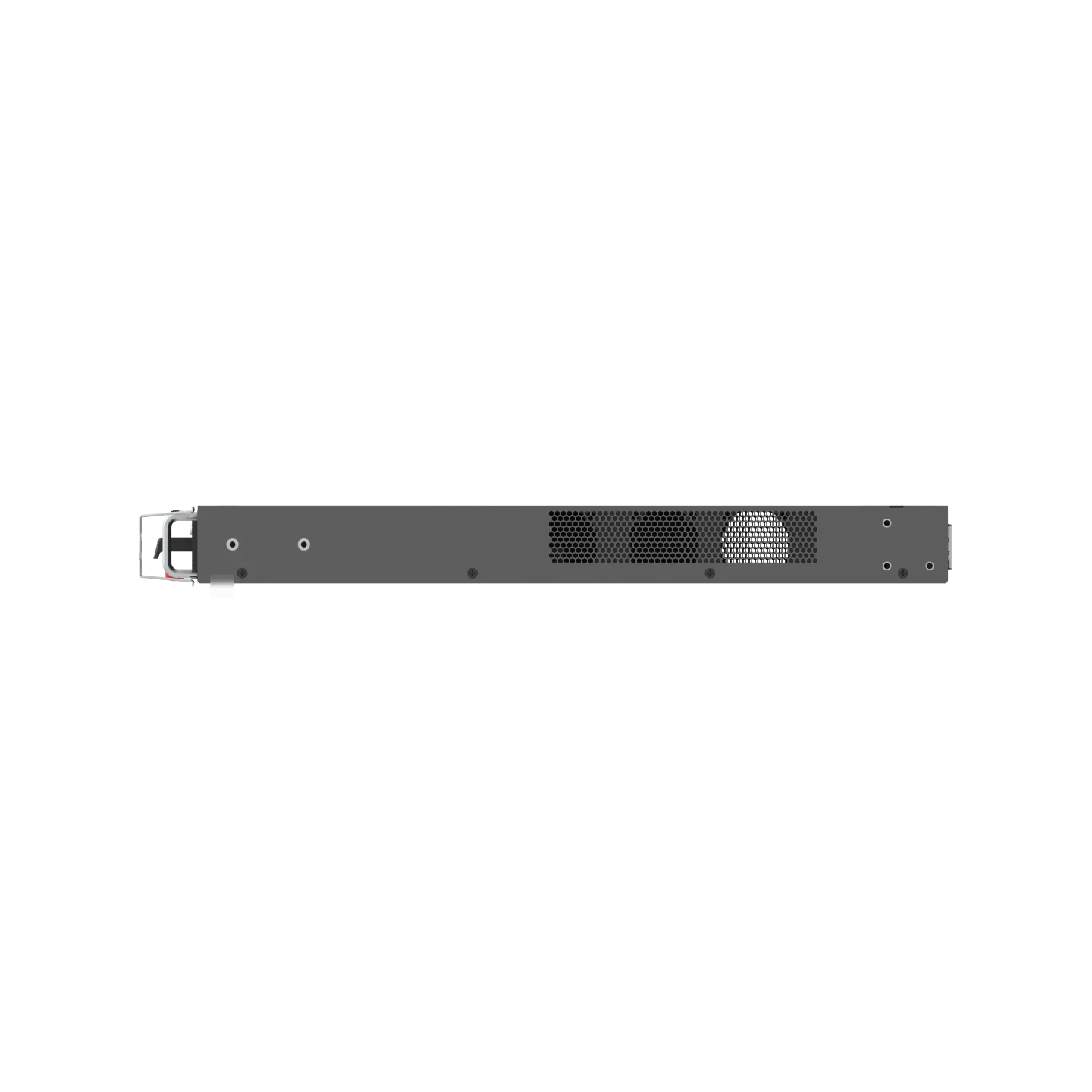
3 x pluggable fan modules |
| Heat dissipation |
Fan cooling, front-to-rear airflow |
| Power module redundancy |
1+1 redundancy |
| Fan redundancy |
2+1 redundancy |
| Power module hot swapping |
Supported |
| USB hot swapping |
Supported |
| Cable hot swapping |
Supported |
| Power supply monitoring |
Monitoring of the power supply model and status Power supply failure alarming |
| Fan monitoring |
Automatic speed adjustment Fan failure alarming |
| Temperature monitoring |
Supported |
| Power supply and consumption |
RG-S6160-48XMG4VS2CQ-UP-X |
| Power supply |
2 x pluggable power modules |
| Power input |
RG-PA600I-P-F (AC input): ● Rated input voltage: 100 V AC to 240 V AC, 50/60 Hz ● Maximum input voltage: 90 V AC to 264 V AC, 47 Hz to 63 Hz ● Maximum input current: 8 A RG-PA1000I-P-F (AC input 1): ● Rated input voltage: 100 V AC to 130 V AC, 50/60 Hz ● Maximum input voltage: 90 V AC to 143 V AC, 47 Hz to 63 Hz ● Maximum input current: 12 A RG-PA1000I-P-F (AC input 2): ● Rated input voltage: 200 V AC to 240 V AC, 50/60 Hz ● Maximum input voltage: 180 V AC to 264 V AC, 47 Hz to 63 Hz ● Maximum input current: 8 A |
| PoE port |
Ports 1 to 24 support PoE/PoE+/PoE++ (IEEE802.3af/at/bt) power supply Ports 25 to 48 support PoE/PoE+ (IEEE 802.3af/at) power supply |
| PoE power cable pairs |
Four pairs (1-2, 3-6, 4-5, and 7-8 pairs) |
| Maximum PoE output power |
Each port of ports 1 to 24 provides up to 90 W of power Each port of ports 25 to 48 provides up to 30 W of power The maximum power depends on the configured power supply 2 x RG-PA1000I-P-F: 1600 W (200 V AC to 240 V AC) |
| Feature |
RG-S6160-X Series |
| Ethernet switching |
Jumbo frame (maximum length: 9,216 bytes) IEEE 802.1Q (supporting 4K VLANs) Maximum number of VLANs that can be created: 4,094 Voice VLAN Super-VLAN and private VLAN MAC address-based, port-based, protocol-based, and IP subnet-based VLAN assignment GVRP Basic QinQ and selective QinQ STP (IEEE 802.1.d), RSTP (IEEE 802.1w), and MSTP (IEEE 802.1s) ERPS (G.8032) LACP (IEEE 802.3ad) LLDP/LLDP-MED |
| IP service |
Static and dynamic ARP DHCP server, DHCP client, DHCP relay, and DHCP snooping DNS DHCPv6 server, DHCPv6 client, DHCPv6 relay, and DHCPv6 snooping Neighbor Discovery (ND) and ND snooping |
| IP routing |
Static routing RIP and RIPng OSPFv2 and OSPFv3 GR IS-ISv4 and IS-ISv6 BGP4 and BGP4+ Equal and Weighted Cost Multi-Path (ECMP) Packet-based and flow-based load balancing Stateless Auto Configuration IPv4/IPv6 VRF IPv4/IPv6 PBR |
| Multicast |
IGMPv1/v2/v3 and IGMP proxy IGMPv1/v2/v3 snooping IGMP filtering and IGMP fast leave PIM-DM, PIM-SM, and PIM-SSM PIM-SSM for IPv4 and IPv6 MSDP to achieve inter-domain multicast MLDv1/v2 MLD snooping MSDP PIM-SMv6 Multicast source IP address check Multicast source port check Multicast querier |
| ACL and QoS |
Standard IP ACLs (hardware ACLs based on IP addresses) Extended IP ACLs (hardware ACLs based on IP addresses or TCP/UDP port numbers) Extended MAC ACLs (hardware ACLs based on source MAC addresses, destination MAC addresses, and optional Ethernet type) Expert-level ACLs (hardware ACLs based on flexible combinations of the VLAN ID, Ethernet type, MAC address, IP address, TCP/UDP port number, protocol type, and time range) Time-based ACLs ACL80 and IPv6 ACL Applying ACLs globally (hardware ACLs based on flexible combinations of the VLAN ID, Ethernet type, MAC address, IP address, TCP/UDP port number, protocol type, and time range) ACL redirection Port traffic identification Port traffic rate limiting 802.1p/DSCP/ToS traffic classification Traffic classification based on 802.1p priorities, DSCP priorities, and IP precedences Traffic classification based on ToS values Congestion management: SP, WRR, DRR, WFQ, SP+WRR, SP+DRR, and SP+WFQ Congestion avoidance: tail drop, RED, and WRED Eight queues on each port Rate limiting in each queue |
| Security |
Multi-AAA RADIUS and TACAS+ Filtering of invalid MAC addresses Broadcast storm suppression Hierarchical management of administrators and password protection BPDU guard RADIUS authentication and authorization Port- and MAC address-based 802.1x authentication IEEE802.1X authentication, MAC address bypass (MAB) authentication, and interface-based and MAC address-based 802.1X authentication Web authentication Hypertext Transfer Protocol Secure (HTTPS) SSHv1 and SSHv2 Global IP-MAC binding ICMPv6 Port security IP source guard SAVI ARP spoofing prevention CPP and NFPP Various attack defense functions including NFPP, ARP anti-spoofing, DHCP/DHCPv6 attack defense, ICMP attack defense, ND attack defense, IP scanning attack defense, and customizing attack defense packet types Loose and strict RPF uRPF ignoring default routes |
| Reliability |
REUP ERPS (G.8032) Rapid Link Detection Protocol (RLDP), Layer 2 link connectivity detection, unidirectional link detection, and VLAN-based loop control Data Link Detection Protocol (DLDP) IPv4 VRRP v2/v3 and IPv6 VRRP BFD GR for RIP, OSPF, and BGP Power modules in 1+1 redundancy mode Hot swapping of power modules and fan modules |
| Device virtualization |
VSU |
| NMS and maintenance |
SPAN, RSPAN, and ERSPAN sFlow NTP and SNTP FTP and TFTP SNMP v1/v2/c3 RMON (1, 2, 3, 9) Various types of RMON groups, including event groups, alarm groups, history groups, and statistics groups, as well as private alarm extension groups RMON used to implement Ethernet statistics, historical statistics, and alarm functions NETCONF Flow-based mirroring, and N:1 and 1:N port mirroring CWMP gRPC OpenFlow Special 1.3 Flow table analysis defined by all protocols Transmission of specified packets to the controller Configuring the controller's IP address and port Notifying port status changes to the controller CLI (Telnet/console), SSH, Syslog, SNMP over IPv6, Telnet v6, FTP/TFTP v6, DNS v6, and NTP for IPv6 Ruijie Could-based management |
| Organization |
Standards and Protocol |
| IETF |
RFC 1058 Routing Information Protocol (RIP) RFC 1157 A Simple Network Management Protocol (SNMP) RFC 1305 Network Time Protocol Version 3 (NTP) RFC 1349 Internet Protocol (IP) RFC 1350 TFTP Protocol (revision 2) RFC 1519 CIDR RFC 1583 OSPF Version 2 RFC 1591 Domain Name System Structure and Delegation RFC 1643 Ethernet Interface MIB RFC 1757 Remote Network Monitoring (RMON) RFC 1812 Requirements for IP Version 4 Router RFC 1901 Introduction to Community-based SNMPv2 RFC 1902-1907 SNMP v2 RFC 1918 Address Allocation for Private Internet RFC 1981 Path MTU Discovery for IP version 6 RFC 1997 BGP Communities Attribute RFC 2131 Dynamic Host Configuration Protocol (DHCP) RFC 2132 DHCP Options and BOOTP Vendor Extensions RFC 2236 IGMP RFC 2328 OSPF Version 2 RFC 2385 Protection of BGP Sessions via the TCP MD5 Signature Option RFC 2439 BGP Route Flap Damping RFC 2460 Internet Protocol, Version 6 (IPv6) RFC 2461 Neighbor Discovery for IP Version 6 (IPv6) RFC 2462 IPv6 Stateless Address Auto configuration RFC 2463 Internet Control Message Protocol for IPv6 (ICMPv6) RFC 2545 Use of BGP 4 Multiprotocol Extensions for IPv6 Inter Domain Routing RFC 2571 SNMP Management Frameworks RFC 2711 IPv6 Router Alert Option RFC 2787 Definitions of Managed Objects for the Virtual Router Redundancy Protocol RFC 2863 The Interfaces Group MIB RFC 2865 Remote Authentication Dial In User Service (RADIUS) RFC 2918 Route Refresh Capability for BGP 4 RFC 2925 Definitions of Managed Objects for Remote Ping, Traceroute, and Lookup Operations (Ping only) RFC 2934 Protocol Independent Multicast MIB for IPv4 RFC 3046 DHCP Option82 RFC 3065 Autonomous System Confederation for BGP RFC 3101 OSPF Not so stubby area option RFC 3137 OSPF Stub Router Advertisement sFlow RFC 3417 (SNMP Transport Mappings) RFC 3418 Management Information Base (MIB) for the Simple Network Management Protocol (SNMP) RFC 3509 Alternative Implementations of OSPF Area Border Routers RFC 3513 IP Version 6 Addressing Architecture RFC 3575 IANA Considerations for RADIUS RFC 3579 RADIUS Support For EAP RFC 3623 Graceful OSPF Restart RFC 3768 VRRP RFC 3810 Multicast Listener Discovery Version 2 (MLDv2) for IPv6 RFC 3973 PIM Dense Mode RFC 4022 MIB for TCP RFC 4271 A Border Gateway Protocol 4 (BGP 4) RFC 4273 Definitions of Managed Objects for BGP 4 RFC 4360 BGP Extended Communities Attribute RFC 4456 BGP Route Reflection: An Alternative to Full Mesh Internal BGP (IBGP) RFC 4486 Subcodes for BGP Cease Notification Message RFC 4552 Authentication/Confidentiality for OSPFv3 RFC 4724 Graceful Restart Mechanism for BGP RFC 4750 OSPFv2 MIB partial support no SetMIB RFC 4760 Multiprotocol Extensions for BGP 4 RFC 4940 IANA Considerations for OSPF RFC 5065 Autonomous System Confederation for BGP RFC 5187 OSPFv3 Graceful Restart RFC 5340 OSPFv3 for IPv6 RFC 5492 Capabilities Advertisement with BGP 4 RFC 6620 FCFS SAVI RFC 768 User Datagram Protocol (UDP) RFC 783 TFTP Protocol (revision 2) RFC 792 Internet Control Message Protocol (ICMP) RFC 793 Transmission Control Protocol (TCP) RFC 813 Window and Acknowledgement Strategy in TCP RFC 815 IP datagram reassembly algorithms RFC 826 Ethernet Address Resolution Protocol (ARP) RFC 854 Telnet Protocol RFC 959 File Transfer Protocol (FTP) |
| IEEE |
IEEE 802.2 Logical Link Control IEEE 802.1ab Link Layer Discovery Protocol IEEE 802.1ad Provider Bridges IEEE 802.1ax/IEEE802.3ad Link Aggregation IEEE 802.1D Media Access Control (MAC) Bridges IEEE 802.1D Spanning Tree Protocol IEEE 802.1Q Virtual Bridged Local Area Networks (VLAN) IEEE 802.1s Multiple Spanning Tree Protocol IEEE 802.1w Rapid Spanning Tree Protocol IEEE 802.3ad Link Aggregation Control Protocol (LACP) IEEE Std 802.3x Full Duplex and flow control *IEEE 802.3az Energy Efficient Ethernet |
The switch, expansion module, power module, and other components can be ordered as needed. Before ordering an expansion module or power module, contact the online customer service personnel for the latest support information about the module.
| Model |
Description |
|
RG-S6160-48XMG4VS2CQ-UP-X
|
48 x 100/1000/2.5G/5G/10GBASE-T ports, 4 x 10GE/25GE SFP28 ports, 2 x 40GE/100GE QSFP+ ports
|
| RG-PA600I-P-F |
600 W AC power module |
| RG-PA1000I-P-F |
1000 W AC power module |
| Model |
Description |
| Mini-GBIC-GT |
1000BASE-X to 1000BASE-T, copper SFP transceiver, RJ45, 100 m over Cat 5e/6/6a The port needs to be configured with auto-negotiation |
| MINI-GBIC-SX-MM850 |
1000BASE-SX, SFP transceiver, 850 nm, Duplex LC, 500 m over MMF |
| MINI-GBIC-LX-SM1310 |
1000BASE-LX, SFP transceiver, 1310 nm, Duplex LC, 10 km over SMF |
| MINI-GBIC-LH40-SM1310 |
1000BASE-LH, SFP transceiver, 1310 nm, Duplex LC, 40 km over SMF |
| MINI-GBIC-ZX80-SM1550 |
1000BASE-ZX, SFP transceiver, 1550 nm, Duplex LC, 80 km over SMF |
| GE-SFP-LX20-SM1310-BIDI |
1000BASE-LX, SFP transceiver, TX1310/RX1550, BiDi LC, 20 km over SMF |
| GE-SFP-LX20-SM1550-BIDI |
1000BASE-LX, SFP transceiver, TX1550/RX1310, BiDi LC, 20 km over SMF |
| GE-SFP-LX03-SM1310-BIDI-I |
1000BASE-LX, SFP transceiver, TX1310/RX1550, BiDi LC, 3 km over SMF |
| GE-SFP-LX03-SM1550-BIDI-I |
1000BASE-LX, SFP transceiver, TX1550/RX1310, BiDi LC, 3 km over SMF |
| Model |
Description |
| XG-SFP-SR-MM850 |
10GBASE-SR, SFP+ transceiver, 850nm, Duplex LC, 300 m over MMF |
| XG-SFP-LR-SM1310 |
10GBASE-LR, SFP+ transceiver, 1310nm, Duplex LC, 10 km over SMF |
| XG-SFP-ER-SM1550 |
10GBASE-ER, SFP+ transceiver, 1550nm, Duplex LC, 40 km over SMF |
| XG-SFP-ZR-SM1550 |
10GBASE-ZR, SFP+ transceiver, 1550nm, Duplex LC, 80 km over SMF |
| XG-SFP-LR10-SM1270-BIDI-I |
10GBASE-LR, SFP+ transceiver, TX1270/RX1330, BiDi LC, 10 km over SMF |
| XG-SFP-LR10-SM1330-BIDI-I |
10GBASE-LR, SFP+ transceiver, TX1330/RX1270, BiDi LC, 10 km over SMF |
| XG-SFP-AOC1M |
10GBASE, SFP+ active optical cable (AOC), 1 m, including one cable and two optical transceivers |
| XG-SFP-AOC3M |
10GBASE, SFP+ active optical cable (AOC), 3 m, including one cable and two optical transceivers |
| XG-SFP-AOC5M |
10GBASE, SFP+ active optical cable (AOC), 5 m, including one cable and two optical transceivers |
| Model |
Description |
| VG-SFP-SR-MM850 |
25GBASE-SR, SFP28 transceiver, 850 nm, Duplex LC, 100 m over OM4 MMF, 70 m over OM3 MMF |
| VG-SFP-AOC7M(M) |
25GBASE, SFP28 active optical cable (AOC), 7 m, including one cable and two optical transceivers |
| Model |
Description |
| 40G-QSFP-LSR-MM850 |
40GBASE-LSR, QSFP+ transceiver, 850 nm, MPO 1 x 12, 400 m over OM4 MMF, 300 m over OM3 MMF |
| 40G-QSFP-LR4-SM1310 |
40GBASE-LR4, QSFP+ transceiver, 1310 nm, Duplex LC, 10 km over SMF |
| 40G-QSFP-iLR4-SM1310 |
40GBASE-iLR4, QSFP+ transceiver, 1310 nm, Duplex LC, 2 km over SMF |
| 40G-AOC-5M |
40GBASE, QSFP+ active optical cable (AOC), 5 m, including one cable and two optical transceivers |
| Model |
Description |
|
100G-QSFP-SR-MM850
|
100GBASE-SR, QSFP28 transceiver, 850 nm, MPO 1 x 12, 100 m over OM4 MMF, 70 m over OM3 MMF
|
|
100G-QSFP-LR4-SM1310
|
100GBASE-LR4, QSFP28 transceiver, 1310 nm, Duplex LC, 10 km over SMF
|
|
100G-AOC-10M
|
100GBASE, QSFP28 active optical cable (AOC), 10 m, including one cable and two optical transceivers
|
Ruijie Networks websites use cookies to deliver and improve the website experience.
See our cookie policy for further details on how we use cookies and how to change your cookie settings.
Cookie Manager
When you visit any website, the website will store or retrieve the information on your browser. This process is mostly in the form of cookies. Such information may involve your personal information, preferences or equipment, and is mainly used to enable the website to provide services in accordance with your expectations. Such information usually does not directly identify your personal information, but it can provide you with a more personalized network experience. We fully respect your privacy, so you can choose not to allow certain types of cookies. You only need to click on the names of different cookie categories to learn more and change the default settings. However, blocking certain types of cookies may affect your website experience and the services we can provide you.
Through this type of cookie, we can count website visits and traffic sources in order to evaluate and improve the performance of our website. This type of cookie can also help us understand the popularity of the page and the activity of visitors on the site. All information collected by such cookies will be aggregated to ensure the anonymity of the information. If you do not allow such cookies, we will have no way of knowing when you visited our website, and we will not be able to monitor website performance.
This type of cookie is necessary for the normal operation of the website and cannot be turned off in our system. Usually, they are only set for the actions you do, which are equivalent to service requests, such as setting your privacy preferences, logging in, or filling out forms. You can set your browser to block or remind you of such cookies, but certain functions of the website will not be available. Such cookies do not store any personally identifiable information.
Contact Us
How can we help you?